
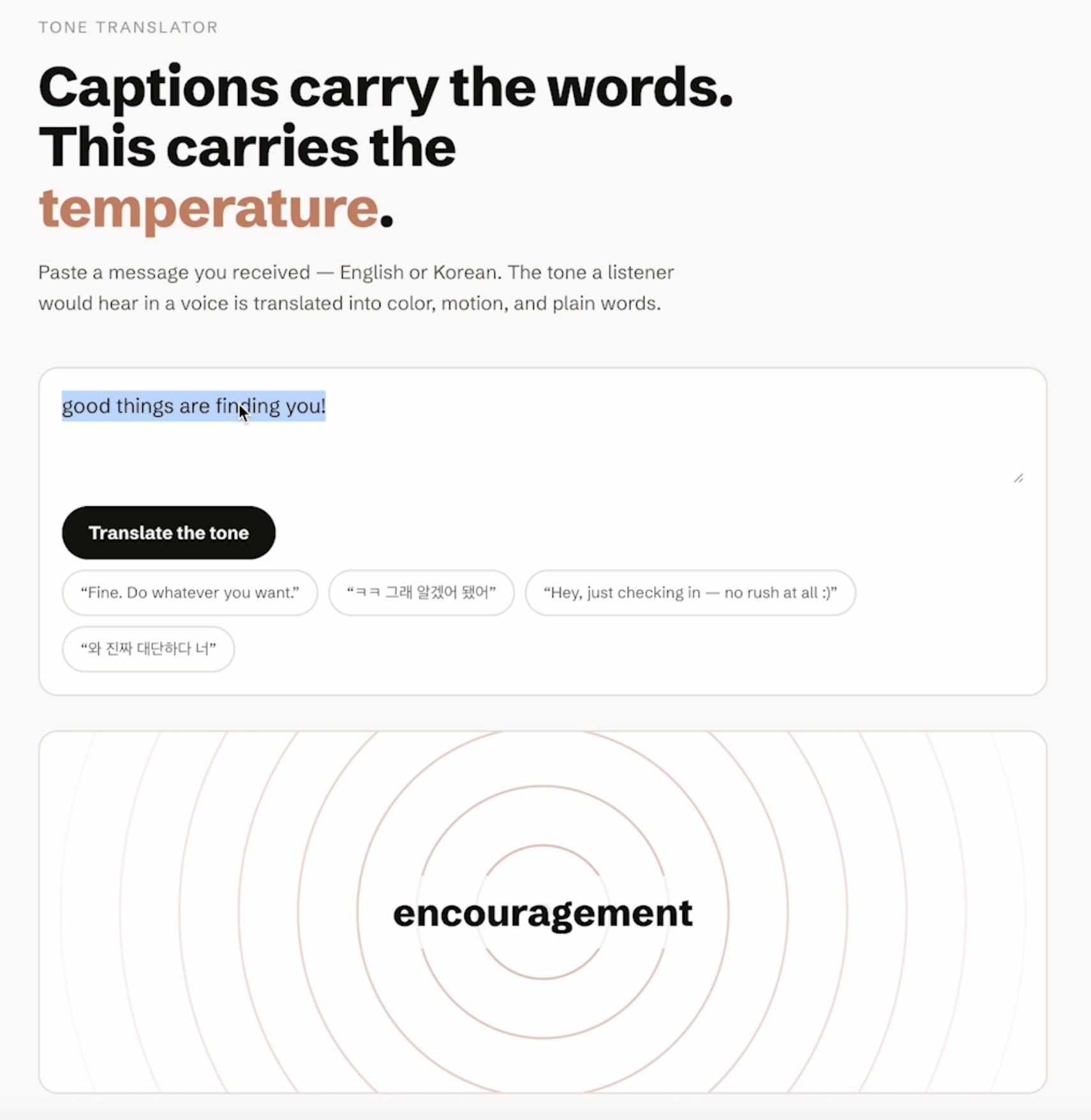
Tone Translator
An AI interface that translates the emotional temperature of messages into color, motion, and plain language.
Role: Concept, Design, Development
Year: 2026
Type: AI Interaction Design / Accessibility Tool
Tools: Claude API (Anthropic), React, HTML Canvas, Prompt Engineering, Figma
Overview
Words carry the emotions. Tone Translator carries the temperature. Growing up with hearing loss, I often had full access to what was said, but not how it was said—the warmth, sarcasm, or tension that hearing listeners pick up instantly from a voice. Tone Translator is an AI-powered interface that reads a text message and translates its emotional tone into three layers: a living ripple visualization, measurable signals, and plain-language interpretation.
The Problem
Assistive technology for deaf and hard-of-hearing people has focused on transcription: converting speech to text. But a transcript is flat. "Fine. Do whatever you want." reads identically whether it is genuine agreement or quiet anger. The emotional layer of communication—prosody, tone, subtext—remains largely inaccessible, and misreading it carries real social cost.
The Approach
Tone Translator uses a large language model (Claude, Anthropic) to analyze a message across five dimensions: temperature (cold to warm), intensity, tension, sarcasm likelihood, and constituent emotions. The analysis is rendered in three complementary forms, so tone can be felt at a glance and understood on inspection:
Ripple visualization — Concentric waves whose color shifts with emotional temperature, speed with intensity, and distortion with underlying tension. The ripple language extends my thesis installation The Weight of Sound, where sound was translated into physical vibration and here, vibration becomes digital.
Signal readout — Temperature, intensity, tension, and sarcasm rendered as measurable values, making ambiguity explicit rather than hidden.
Three readings — "What the words say," "What the tone carries," and "How to read it": literal meaning, subtext, and honest guidance that acknowledges when a tone could go two ways.
The tool works bilingually in English and Korean, reflecting my own bilingual communication life.
Design Decisions
The interface deliberately avoids claiming certainty. Emotion detection by AI is probabilistic, so the design surfaces likelihood, not verdicts—sarcasm is a percentage, and the reading guide is written to admit ambiguity. Accessibility tools should expand a person's judgment, not replace it.
Reflection
This project continues a thread that began in high school, when I built a wearable captioning prototype with an Arduino and a small display—years before real-time AI captioning glasses existed. Tone Translator asks the next question: now that we can access the words, how do we access the feeling? It is an early study for a longer research interest in translating invisible experiences into forms that can be felt, not just seen.